What Is the Best China PDLC Window Film for Global Buyers?
Choosing the right Pdlc Window Film is not simply a matter of selecting the clearest switchable glass effect. Global buyers must evaluate performance, safety, installation conditions, and supplier reliability together. A film that looks impressive in a showroom may behave differently beside a sunny window, in a humid hotel, or across a large office partition.
This guide examines what makes a Pdlc Window Film suitable for international projects. It considers switching speed, visible light transmission, privacy levels, power consumption, adhesive quality, and expected service life. It also reviews practical details, including transformer compatibility, glass preparation, edge sealing, wiring design, and local installation skills. Small details matter. Poor alignment can create visible lines, while weak electrical planning may cause uneven performance.
Reliable purchasing requires evidence, not attractive photographs. Experienced suppliers should provide technical datasheets, sample testing, quality-control records, and clear warranty terms. Buyers should also confirm whether the product has been tested for electrical safety, fire behavior, and environmental durability in the target market. Standards and certification requirements vary by region, so professional local advice remains important.
There is no universal best film. That answer sounds convenient, but it is incomplete. A premium product may be unsuitable for a budget renovation or an irregular glass surface. Real project conditions often expose weaknesses that product brochures omit. By comparing measurable specifications with installation experience and supplier support, global buyers can make a more dependable decision and avoid costly replacement work later.
PDLC Window Film Explained: Structure, Switching Modes, and Key Uses
What Is the Best China PDLC Window Film for Global Buyers?
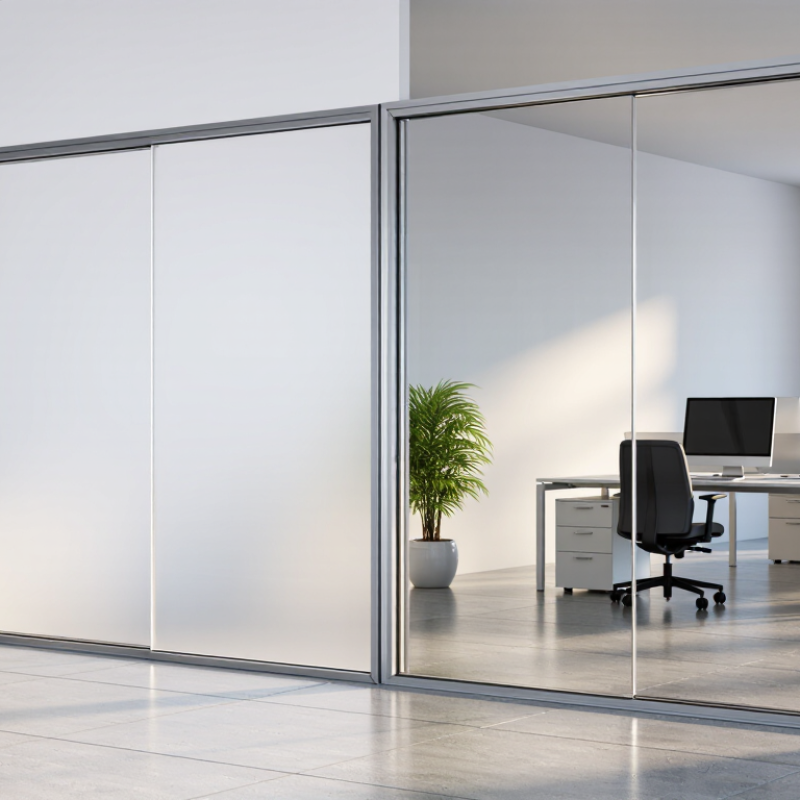
PDLC window film uses a liquid crystal layer between transparent conductive films. A polymer matrix holds the crystals in place. PET layers and pressure-sensitive adhesive protect the assembly. When electricity is off, the crystals scatter light, creating a frosted appearance. Power aligns them, producing a clearer view. Some projects use reverse switching modes. The correct mode depends on safety, privacy, and control requirements.
In real installations, PDLC film can divide meeting rooms, cover clinic partitions, or create private retail displays. It also supports rear projection in darker spaces. However, “clear” does not always mean perfectly transparent. Haze, glass color, wiring, and sunlight can affect the result. Film size, voltage, switching speed, and heat performance deserve careful checking. Global buyers should request test data and confirm electrical certifications for the destination market. Installation quality matters greatly. Even good film can show bubbles or edge lifting when the glass is poorly prepared.
Tips: Ask for a physical sample before placing a large order. Test it on the actual glass type. Check the viewing angle in daylight. Confirm the warranty conditions and replacement process. Do not judge performance from photographs alone. They often hide haze and reflections. One detail is easy to overlook: control compatibility. A wall switch, remote controller, or smart system may require different wiring. No specification is perfect, so record what the project truly needs before comparing suppliers.
Core Specifications: 0.1–1-Second Switching, 99% UV Blocking, and Haze
What Is the Best China PDLC Window Film for Global Buyers?
For global buyers, the best PDLC window film starts with measurable performance, not attractive product photos. A switching speed of 0.1–1 second can create instant privacy in meeting rooms, clinics, and hotel bathrooms. However, timing may change with panel size, temperature, wiring, and power quality. Ask suppliers to define their test conditions clearly. A real sample test is more useful than a perfect catalog claim.
UV blocking should reach 99% to help protect flooring, artwork, furniture, and displayed products from ultraviolet exposure. Yet buyers should check whether this figure covers the complete film system or only one layer. Haze also deserves careful attention. Low haze keeps text and faces clearer in transparent mode, while higher haze can make images look soft. I once judged a sample under showroom lighting and missed its cloudy appearance near a bright window. That mistake was avoidable.
Tips: Test switching at room temperature and after several hours of operation. Measure haze from different viewing angles. Check the power supply, adhesive quality, edge sealing, and installation instructions. Request independent test reports, production samples, and a written warranty. Do not ignore small details. Film thickness, cut accuracy, and connector placement can affect the final result. Performance may be excellent, but installation remains a practical weakness.
What Is the Best China PDLC Window Film for Global Buyers?
Core specifications include 0.1–1-second switching, approximately 99% UV blocking, high clear-state transmittance, and low haze. The chart presents representative technical reference values for evaluating PDLC window film performance.
Reference values may vary according to film construction, glass configuration, controller settings, and test standards. Switching time is shown in seconds; optical performance is shown as a percentage.
Global Compliance Checks: CE, RoHS, REACH, IEC, and UL Documentation
For global buyers, the best China PDLC window film is not simply the clearest film. It needs traceable compliance evidence. CE marking requires a supplier’s Declaration of Conformity, technical file, and risk assessment. It is not automatically a third-party certificate. RoHS limits ten restricted substances, while ECHA’s Candidate List contained 241 substances by June 2024. Ask for recent material declarations, not old laboratory scans.
REACH evidence should cover chemical composition, SVHC communication, and supply-chain responsibilities. IEC documents should identify the exact testing methods, voltage ratings, and environmental conditions. UL documentation must state the tested construction, thickness, adhesive, wiring, and intended use. A report for a power controller may not cover the film itself. The distinction is easy to miss. The European Commission’s Safety Gate report recorded more than 3,400 product alerts in 2023, showing why document checking matters. Compliance paperwork can still be incomplete.
Tips: Request serial-numbered test reports from an ISO/IEC 17025 laboratory. Match every report to the shipped film and controller. Check test dates, sample descriptions, and authorized signatures. Compare the declared voltage with your installation design. Also request flame, insulation, and electrical-safety data where relevant. IEC 62321 methods can support restricted-substance testing. In practice, buyers sometimes trust a logo too quickly. That is a weakness worth correcting.
How to Select China PDLC Film: Testing, MOQ, Warranty, and Landed Cost
What Is the Best China PDLC Window Film for Global Buyers?
How to Select China PDLC Film: Testing, MOQ, Warranty, and Landed Cost
Selecting PDLC film from China requires more than comparing quoted prices. Request a physical sample, wiring diagram, and recent test records. Test it inside the intended glass frame, not only on a showroom panel. Check switching speed, haze, light transmission, insulation, and power consumption. Test it live.
For commercial projects, inspect switching cycles and adhesive performance under heat and humidity. A sample measuring one by two meters can reveal edge lifting, uneven opacity, or visible wiring problems. Ask whether tests were performed internally or by an independent laboratory. Batch traceability also matters. One overlooked detail can affect an entire installation.
MOQ should match your project timeline and cash flow. A low unit price may hide high carton quantities, custom tooling, or expensive replacement samples. Calculate the landed cost, including film, controllers, packaging, freight, insurance, import duties, and local delivery. Get each charge in writing. Warranty terms deserve the same attention. Confirm coverage length, switching-cycle limits, installation responsibilities, storage conditions, and response procedures. Some warranties sound generous but exclude moisture, incorrect voltage, or poor glass preparation. That is where buyers often learn too late. A careful supplier should provide clear documents, realistic lead times, and support for troubleshooting. My own view is cautious: a perfect sample proves little unless production consistency is verified. Ask for a pre-shipment inspection or retain an approved reference sample. Imperfect planning is still cheaper than replacing installed film.